

18 Aug Breaking Down Silos: A New Way to Connect Job Seekers & Employers
 Your team works hard to get candidates job-ready, but navigating Charlotte’s complex network of employer programs, funding streams, and support services shouldn’t feel like a full-time job. Outdated resource lists and endless web links often lead to warm leads going cold.
That is exactly what CELC Innovation Day set out to fix.
Powered by the Truist Rapid Innovation Program, non-profit leaders, business executives, and local officials came together to stop working in silos and start building tools that actually make sense for our workforce ecosystem.
Instead of another giant directory, we are building an intuitive, AI-powered system designed to act as a personalized guide. For community partners, this means an easier way to navigate Charlotte’s business landscape, seamlessly connect your participants to the exact programs and employer pipelines that fit their skills, and create warm handoffs with no extra steps.
Spotlighting Digital Inclusion & Civic Trust
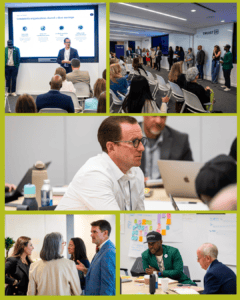
Led in strategic partnership by CELC Executive Director and Charlotte Works Board Vice Chair Blair Stanford, teams spent the day mapping out solutions to fix broken connections between employers, job seekers, and partners. Charlotte Works President and CEO Anna London led sessions on getting next-generation talent ready for immediate hiring demands, while Chief Impact Officer Kevin Loux focused on helping experienced workers transition into open roles across our region.
Bruce Clark, Executive Director of the Center for Digital Equity (CDE) at Queens University of Charlotte, co-led the Community Partners Room alongside Kathryn Firmin-Sellers and the United Way of Greater Charlotte.
As Clark summarized, rather than evaluating the tool as a demo, the room took on a harder question: how does something like this get installed into the civic infrastructure of a community so residents actually use it and get somewhere with it? Digital Navigators tested the tool against real scenarios, where a resident arrives with an internet, device, or housing need and a workforce need surfaces mid-conversation. The group worked through what builds trust in a tool like this, who keeps its information accurate over time, how frontline staff get trained, and where human support stays essential.
“A tool only creates opportunity if people trust it enough to use it,” Clark said. “The real work is installing it into the civic infrastructure a community already relies on.”
He added, “we spent less time on whether the tool works and more on how it gets installed into a community. A resident will use something like this if it reaches them through an organization they already trust, if the person in front of them knows how to use it, and if it leads somewhere real in their life. Technology is one input toward opportunity. Trust and relationships are the others.”
Charlotte Works Chief Impact Officer Kevin Loux echoed that vision for real-time impact: “Static directories can’t prepare individuals for tomorrow using yesterday’s data in an ever-evolving labor market. By leveraging generative AI to analyze workforce trends and skill matches in real time, this system transforms passive lists into an active recommendation engine. It bridges the gap between community referral pipelines and real-time employer demand, eliminating the data friction that keeps qualified talent sitting on the sidelines.”
Looking Ahead: Tech Rising Summit
The Center for Digital Equity returns to the Truist Innovation and Technology Center in October for the Tech Rising Summit, bringing together employers, community organizations, and residents around practical digital skills and AI readiness.
Click here to register for the Tech Rising Summit.
Stay Connected as We Build
Our teams are establishing clear roadmaps to roll this tool out, making it faster and easier for community organizations to connect with the right resources and amplify local impact.
Want to stay updated as this tool is built? Sign up for our newsletter to receive notifications.