


19 Aug AI and Entry-Level Hiring: What New Job Data Reveals
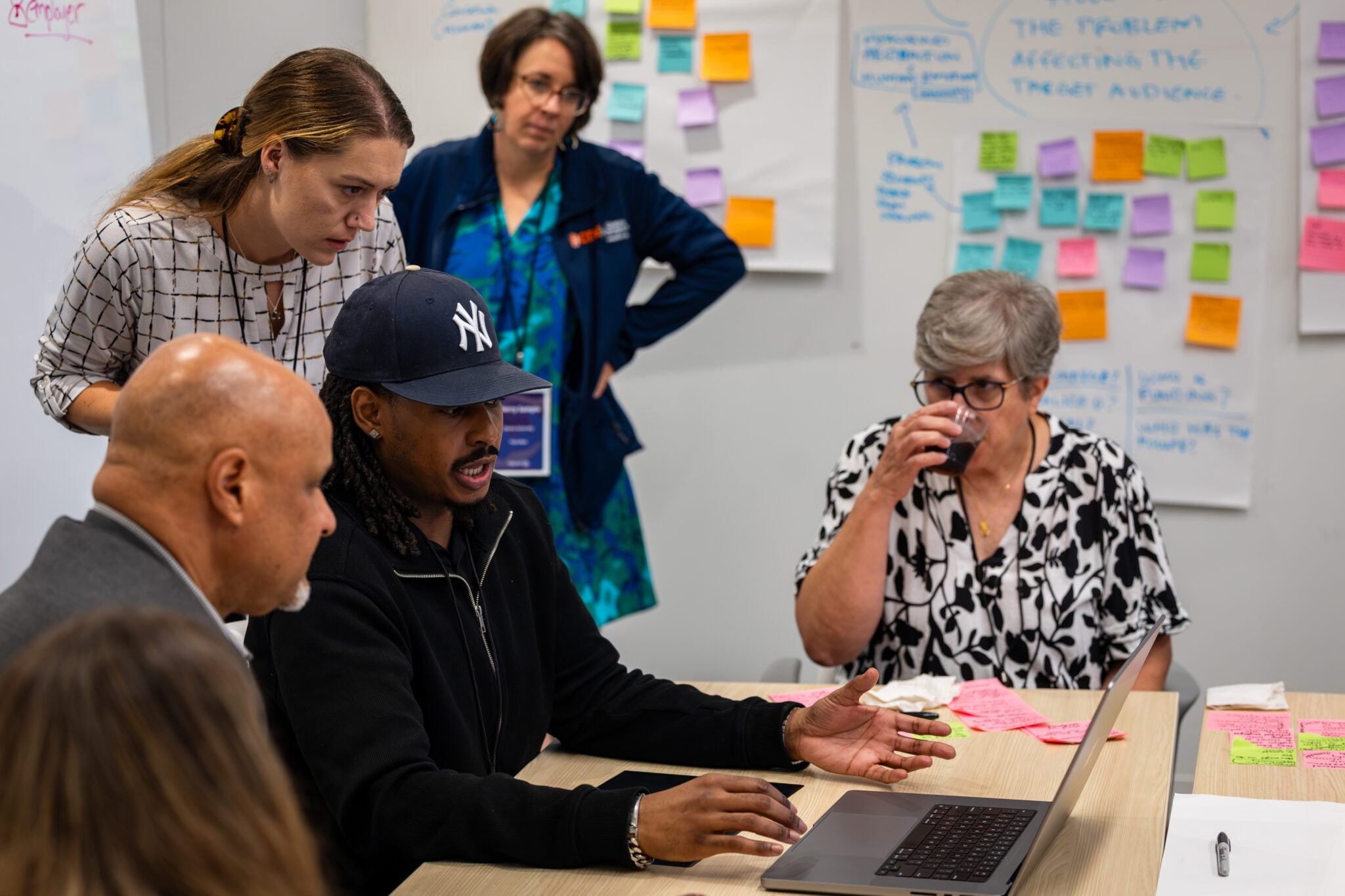
As artificial intelligence reshapes entry-level hiring across the region (and how local workforce boards write blog posts), community partners play a vital role in helping local job seekers adapt, upskill, and remain competitive. Trust between these partners and residents is the essential element to build a bridge to opportunity for residents through AI.
Entry level hiring has declined in the U.S. labor market. In May 2026, entry level job postings on Indeed were down 7.5 percent from a year earlier, while senior level postings were up 14.7 percent. By June 30, Indeed’s Job Postings Index stood at 101.0, close to its February 2020 baseline, and 3.7 percent below a year earlier. Postings listing AI skills increased 144 percent over the year through April 2026, compared with 7 percent growth in postings overall. Indeed’s AI Tracker showed that 45 percent of data and analytics postings mentioned AI by December 2025. AI skills requirements are appearing in more job descriptions, alongside communication, problem solving, judgment and teamwork. Demand extends beyond technology into finance, higher education, engineering and accounting.
Entry level positions still accounted for 46 percent of postings nationwide, however, young workers are experiencing changes in occupations where AI can perform a greater share of work tasks. Employment among workers ages 22 to 25 in these occupations was at about 19 percent below the level it would have reached if employment had moved at the same pace as young workers in occupations where AI has a smaller role. The gap was 15 percent in July 2025 and reached 19 percent by June 2026. Much of the difference appeared through reduced hiring of young workers.
A Brookings Institution analysis identified 6.1 million workers in occupations where AI may affect a large share of tasks and where workers also have fewer resources available during a job transition. Most of these occupations are in clerical and administrative occupations with women accounting for 86 percent of the group studied. Factors such as savings, age, local job opportunities and the ability to use existing skills in another entry-level occupation increase the level of difficulty of some workers in the labor market. No occupation is immune to AI shifts and integrating in-demand AI skills in the local workforce community and at all levels of training are crucial in the current labor markets. These findings are helpful for training providers and workforce development groups as these entities strategize community partnerships with employers to assist entry level jobseekers with AI skills expectations on the job.
Charlotte Works, over the years, developed an outcome-oriented network that connects employers with organizations preparing people for work. Charlotte Works brings together businesses, education providers, government agencies and community organizations through the Charlotte Mecklenburg Workforce Development Providers Council and regular community partner meetings. As AI changes entry level job requirements, this network gives local partners direct opportunities to compare hiring needs with training programs. Businesses share changes in job duties and hiring practices. Training providers review course content and credentials. Community organizations connect residents with training, work experience and employment services. Charlotte Works also offers targeted resources through its NCWorks NextGen program for youth and young adults ages 16-24, providing career advising, work experience, and instruction in Working Smart–a soft-skills curriculum focused on communication, problem solving, time management, accountability, and employer expectations.
By: Akofa Dossou, Senior Economic Analyst
References
Brynjolfsson, E., Chandar, B., & Chen, R. (2026, August 12). No Widespread Displacement, but the AI Employment Gap for Young Workers Has Widened to 19%. Stanford Digital Economy Lab.
Aidala, F., & Puri, S. (2026, July 23). The Labor Market Is Tilting Toward Seniority. Indeed Hiring Lab.
Indeed Hiring Lab. (2026, July 23). US Labor Market Snapshot: June 2026.
Stahle, C. (2026, January 22). January 2026 US Labor Market Update: Jobs Mentioning AI Are Growing Amid Broader Hiring Weakness. Indeed Hiring Lab.
Manning, S., Aguirre, T., Muro, M., & Methkupally, S. (2026, January 21). Measuring US Workers’ Capacity to Adapt to AI Driven Job Displacement. Brookings Institution.
Stangler, D. (2026, May 14). Navigating Skills Trends: Data Dashboard Analysis, April 2026. Bipartisan Policy Center.
Charlotte Works. (2026). Community Partners.